25 October 2008

Beta-Blockers Might Not Offer Heart Protection

If you look at the way beta-blockers are described and defined here, you may get the idea that it offers cardioprotection. That means it protects the heart in cases of chest pains associated with poor blood supply to the heart, in cases of high blood pressure or hypertension, and when a heart attack has already occurred.

A new study published in the recent issue of the Journal of the American College of Cardiology said otherwise.

Part of the study results said:
Paradoxically, a lower heart rate (as attained in the beta-blocker group at study end) was associated with a greater risk for the end points of all-cause mortality (r = –0.51;), cardiovascular mortality (r = –0.61;), myocardial infarction (r = –0.85;), stroke (r = –0.20;), or heart failure
(r = –0.64;).
~ JACC, Vol.52, No.18, 28 Oct. 2008

This is an alarming result. Doctors prescribe beta-blockers to patients in the hope of improving their clinical outcomes. If doing so results in creating unfavorable outcomes, then a revision of treatment modalities must be studied immediately.

The study's conclusion worries me:
"In contrast to patients with myocardial infarction and heart failure, beta-blocker–associated reduction in heart rate increased the risk of cardiovascular events and death for hypertensive patients."

20 October 2008

Health Status of 2008 US Candidates

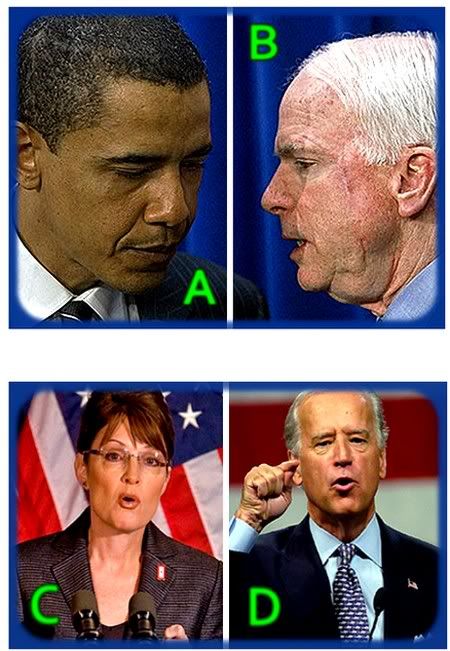
Obama, McCain, Palin, and Biden. How well do you know the health status of this year's US presidential and vice-presidential nominees? Can you answer the short quiz below?


QUESTIONS:
  1. Who is the candidate given last rites by a Roman Catholic priest in 1988 because of a ruptured aneurysm?
  2. Who is the only candidate among the four above who has not released any medical or health information about herself?
  3. Who is the candidate who might need joint replacements soon, according to his Mayo Clinic doctor?
  4. Who is the candidate having problems about quitting smoking?
  5. Who is the candidate who attempted suicide in the past?
  6. Who among the four above has kidney stones?
  7. Who has an enlarged prostate?
  8. Who is the candidate who underwent extensive surgery on the face and neck to remove melanomas in August, 2000?
  9. Who is the candidate suffering from chronic sinusitis and allergies?
  10. Who are the two candidates taking statins to control their cholesterol levels?
The answers are here. My source is a recent New York Times article written by Dr. Lawrence K. Altman.

I agree with the good doctor that people have a right to know the true health conditions of the candidates. The four candidates must be open enough to let everyone know how healthy or how sick they really are.

Every country needs healthy leaders.

14 October 2008

Vioxx Risk Confirmed

A long-term analysis of people who took the arthritis drug Vioxx confirms it doubles the risk of strokes and heart attacks, researchers said on Monday, but this risk goes away a year after people stop taking it.

And other drugs in the same class of painkillers known as Cox-2 inhibitors
may cause similar harm, they said.

"The good news is the data suggests that the risk doesn't persist forever. The risk goes back toward normal after a year of follow up," said Dr. Robert Bresalier of the M.D. Anderson Cancer Center at the University of Texas, whose study appears in the journal Lancet.
~ Reuters, 13 Oct 2008

You can read the study's abstract here.

Most prescription medicines are doubled-edged. Sure, they do what they are advertised to do, but not everyone reads the fine print that says that these medications are also sometimes responsible for unwanted side-effects. Yes, as in the rofecoxib or Vioxx case, no one wants to get those risks relating to heart attacks and stroke.

Prescription medicine defenders will say that it is all about probabilities. The said risks will only affect a small fraction of the population taking the medication. While that is true and doctors know that, too, what no one knows is who belongs to that small fraction. It can be anyone. And just because the unwanted risks affect only the small fraction does not lessen the importance of being careful when taking these medicines.

Patients depend on doctors when making a decision like this. Decision-making is a heavy burden for doctors most of the time, because there is really no fool-proof and sure way of knowing how each patient will react to a set of medications. Each patient is always unique, and therefore, clinical management is often, and must be tailored to the patient's needs.

The study above is an eye-opener. Let's hope it helps both doctors and patients in deciding what is the best treatment option available.

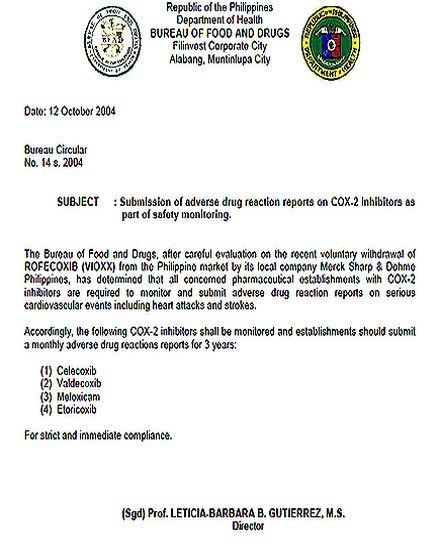
In the Philippines, Vioxx is said to have been voluntarily removed from the pharmacies by its manufacturer since 2004. I came across the BFAD letter below, but I still have no data what came about after this was issued.

10 October 2008

Red Wine May Protect Smokers and Ex-Smokers from Lung Cancer

Drinking red wine, but not white wine, may reduce lung cancer risk, especially among current and ex-smokers, new research indicates.

People who had ever smoked and who drank at least a glass of red wine daily were
60 percent less likely to develop lung cancer than ever-smokers who didn't drink alcohol, Dr. Chun Chao of Kaiser Permanente Southern California in Pasadena and colleagues found.

But white wine
didn't reduce risk, suggesting it could be compounds contained in red wine, such as resveratrol and flavonoids, rather than the healthier lifestyle associated with wine drinking, that may be protective, the researchers say. ~ Reuters, 9 Oct 2008

Another good news, alright, but do not let it devolve later on as a terrible excuse to smoke. Quitting smoking remains to be one of the best, if not, the best way to avoid getting lung cancer.

07 October 2008

Cough and Cold Meds Not For Children

Oral cough and cold medicines sold over the counter should not be used in children younger than 4 years old because of the risk of rare complications linked to inappropriate use, a U.S. industry group said on Tuesday.

The Consumer Healthcare Products Association, which represents
Procter & Gamble Co, Novartis AG and other companies, said most of the problems occurred in children who were given the wrong dose or who took the medicine accidentally.

"We're doing this out of an
abundance of caution," the group's president, Linda Suydam, said. ~ Reuters, 7 Oct 2008

This is good news. The initiative came from the makers themselves.

The term - "complications linked to inappropriate use" can mean seizures and stroke on children taking these OTC medicines.

What are some of these OTC medications?
Products available without a prescription include Wyeth's Dimetapp, and Procter & Gamble's NyQuil, Novartis AG's Triaminic, and Johnson & Johnson's Tylenol and PediaCare, among others.

The industry's move only applies to
syrups, pills and tablets and does not include nasal sprays, inhaled medicines, lotions or rubs.

02 October 2008

Breakfast Cereals: Too Sweet!

Post Golden Crisp made by Kraft Foods Inc and Kellogg's Honey Smacks are more than 50 percent sugar by weight, the group said, while nine brands are at least 40 percent sugar.

The most healthful brands are
Cheerios with three grams of fiber per serving and one gram of sugar, Kix, and Honey Nut Cheerios, all made by General Mills, and Life, made by Pepsico Inc's Quaker Oats unit.

"Be sure to
read the product labels, and choose cereals that are high in fiber and low in sugar and sodium," Gayle Williams, deputy editor of Consumer Reports Health, said in a statement. ~ Reuters, 1 Oct 2008

Most consumers here do not read product labels. Also, breakfast cereals are expensive especially the imported ones. In a developing country, most consumers know that price concerns overtake healthy options.

Another concern is the current Chinese melamine scare. Sure, now we know how unhealthily sweet some of these cereals are, but how safe are they when it comes to melamine contamination?